AI hyper personalization
For the ten years people in marketing have been talking about making things personal for the customer. They had to say it was part of their plan. For a lot of them it was just about putting the customers name at the start of a big email that went to lots of people.
That time is gone now.
We are seeing a change in the way people do marketing on computers. People are getting much of the same information rules about privacy are making it hard to get information from other people and computers are getting really good at doing things on their own with something called Artificial Intelligence.
All these things are happening at the time and it has led to a new way of doing things: using computers to make things really personal for each customer.
This is not just about knowing when a customer was born. It is about knowing what they need before they even think about it.. It is, about giving each customer a special experience when they use our service right away no matter how they are using it.
Hyper-personalization is an advanced marketing strategy that uses artificial intelligence (AI), machine learning (ML), real-time data, and customer analytics to deliver highly personalized content, product recommendations, offers, and experiences to individual users. Unlike traditional personalization, which relies on basic information such as a customer's name or purchase history, hyper-personalization analyzes multiple data points—including browsing behavior, location, preferences, search history, device usage, and real-time interactions—to create tailored experiences that meet each customer's unique needs.
In social media marketing, hyper-personalization enables brands to deliver the right message to the right audience at the right time. For example, an e-commerce company may recommend products based on a user's recent searches, while a streaming platform suggests content based on viewing habits. Social media platforms such as Instagram, Facebook, and LinkedIn also use AI-driven algorithms to personalize users' feeds and advertisements, increasing engagement and conversion rates.
The key benefits of hyper-personalization include improved customer satisfaction, higher engagement, increased conversion rates, stronger brand loyalty, and better return on investment (ROI). However, implementing hyper-personalization also presents challenges, such as ensuring data privacy, complying with regulations, maintaining data accuracy, and balancing personalization with ethical use of customer information.
As AI and data analytics continue to evolve, hyper-personalization is becoming a critical trend in Social Media Marketing (SMM), helping businesses create meaningful, customer-centric experiences that drive long-term growth and competitive advantage.
The Shift from Static to Dynamic-
Hyper Personalization
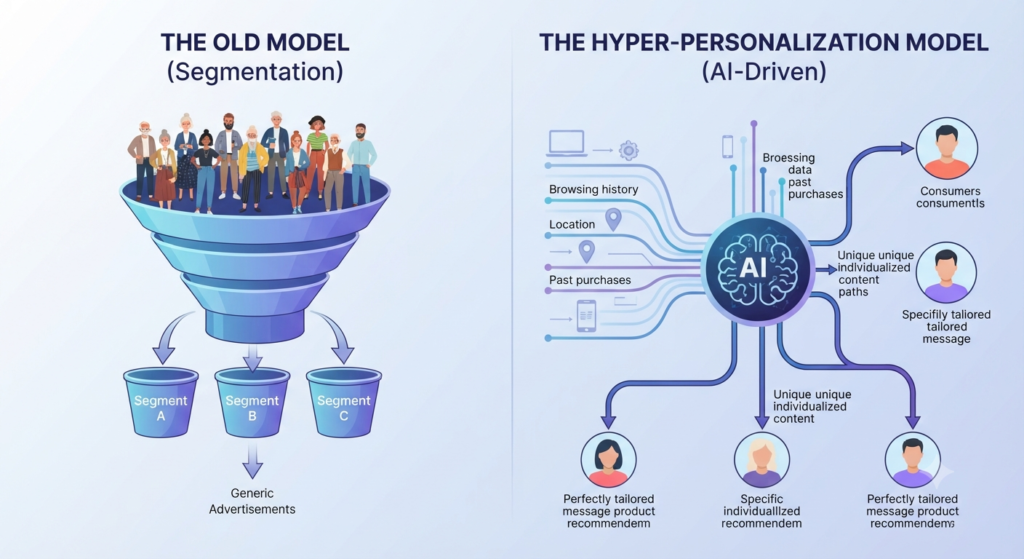
Traditional marketing used to group people together based on things like their age and where they live for example men who're thirty years old and live in cities.
With Hyper Personalization every single person is treated like they are their own group.
It uses computer programs to look at a lot of information about what people have bought what they do when they visit a website and how they interact with things on the site.
It even tries to figure out how people are feeling.
Then the computer puts together a message, offer or piece of content that's just right for that person, at that exact moment using Hyper Personalization and Hyper Personalization techniques.
The Key Pillars of Hyper Personalization
To get to this way of doing things with artificial intelligence your plan for using computers and the internet has to have three important parts:
1. Using Data Now
The information has to be current. What a customer was doing on your website yesterday is not as important as what they're doing at this moment. You need to have a system that brings together all the information from your website, app, customer relationship management tool and email. This is called a Customer Data Platform. It helps you see each customer as a person and it updates very quickly.
2. Artificial Intelligence That Can Predict Things and Figure Out What Customers Might Do
It is not enough to know what a customer did before. You have to use intelligence to try to figure out what they will do next. What will this customer probably buy next? Are they likely to stop being a customer? Are they the kind of customer who would be interested in an offer? The artificial intelligence gives scores to these questions. It changes the way you market to them automatically.
3. Creating Content That Changes
When the artificial intelligence knows who to target and what to offer them it has to come up with the content. There are tools now that can make different versions of advertisements, email subject lines and even pictures that are tailored to what each person likes and where they are, in the process of buying something.
NEED TO SHOWCASE YOUR PLATFORMS-DON'T WORRY! JUST DM